Emergency Roof Leak Repair & Storm Damage Triage in North Little Rock, AR
North Little Rock sits across the Arkansas River directly opposite downtown Little Rock, encompassing historic neighborhoods like Park Hill and Argenta, sprawling residential areas such as Lakewood, and substantial commercial distribution centers along the I-40 corridor. The city experiences severe seasonal severe thunderstorms, straight-line microburst winds, and hail that rip through aging asphalt shingle courses and low-slope commercial roofs. Roof Expert USA connects North Little Rock residential and business property owners with licensed, independent Arkansas roofing contractors for rapid emergency water containment and forensic roof damage inspections.
1. Local Storm Dynamics & Severe Wind Exposure
North Little Rock's geographical orientation along the northern river bluffs and flat alluvial river valley creates microclimate wind acceleration during convective storm systems. Strong thunderstorm squalls and tornadic shear lines channel high-velocity winds across the Arkansas River, funneling straight into residential roof rakes and eaves. In historic districts like Park Hill, architectural roofing systems frequently feature steep gables, complex valley transitions, and aging plank decking vulnerable to sudden water intrusion. When convective downpours deposit multiple inches of rain within an hour, water pushes beneath lifted shingle tabs, saturates historic framing, and drips into interior plaster ceilings. On flat commercial properties along Maumelle Boulevard and East Broadway, severe winds lift perimeter parapet metal copings, creating catastrophic avenues for roof deluge.
2. Non-Destructive Moisture Diagnostics & FLIR Thermal Tracing
Precision non-destructive diagnostic evaluations are essential across North Little Rock's diverse architectural landscape. Dispatched contractors utilize calibrated FLIR infrared thermal imaging cameras to inspect interior ceilings and attic spaces during post-storm triage. Thermal scans instantly identify cool temperature anomalies caused by evaporating moisture trapped behind drywall, tongue-and-groove boards, and structural masonry. Electronic pinless moisture meters verify substrate moisture levels across roof decking, ensuring that contractors accurately delineate the full boundaries of water damage without intrusive exploratory holes.
Localized Storm Damage & Repair Protocols
- North Little Rock & Riverfront Corridor Priority Dispatch operating 24/7.
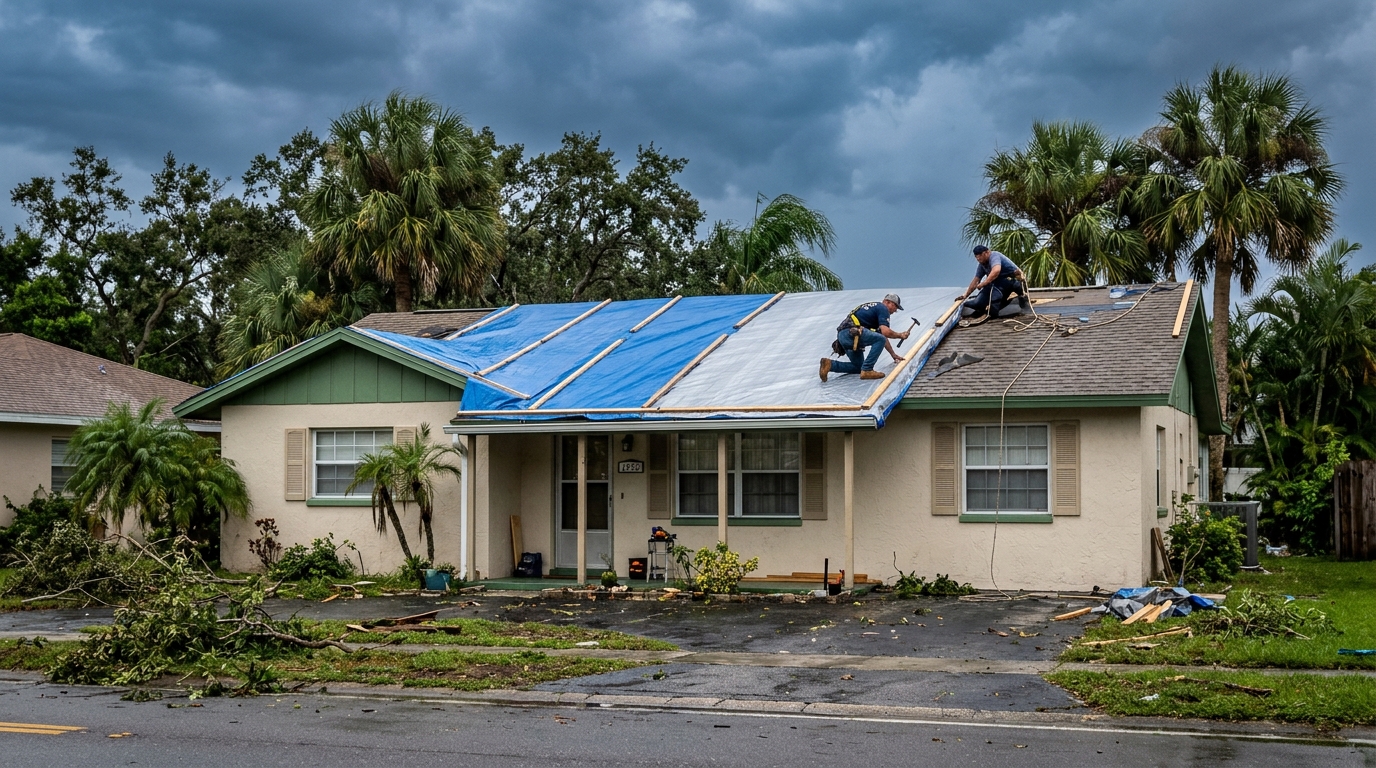
- Engineered High-Wind 12-Mil Poly Tarps Secured with Rafter-Anchored Battens.
- Non-Destructive Calibrated FLIR Infrared Thermal Moisture Leak Mapping.
- Independent Arkansas Contractors Licensed with Arkansas Contractors Licensing Board.
3. Step-by-Step Substrate Restoration & Weatherproofing Methodology
Restoration methodology focuses on immediate structural stabilization followed by permanent, code-compliant reconstruction. For emergency water containment, crews install heavy 12-mil cross-laminated woven polyethylene tarps wrapped around continuous 1x2 dimensional spruce battens and anchored securely into structural roof rafters. On commercial low-slope buildings, technicians apply industrial polyurethane wet-seal mastics and reinforced elastomeric flashing membranes around compromised parapet walls and drain collars. For permanent restoration, damaged decking is replaced with APA-rated exterior CDX plywood, covered with self-adhering SBS modified bitumen ice-and-water shield, and finished with high-wind rated dimensional architectural shingles nailed with six-fastener patterns.
4. Arkansas Building Code Compliance & Contractor Licensing
All emergency mitigation and roof repairs comply with the Arkansas Fire Prevention Code (incorporating the IRC and IBC) and City of North Little Rock municipal building regulations. Dispatched independent contractors hold active licenses with the Arkansas Contractors Licensing Board under commercial or residential roofing classifications. Technicians operate under strict OSHA fall safety protocols (29 CFR 1926.501), utilizing certified roof anchor brackets, full-body harnesses, and shock-absorbing lanyards on all steep-slope residential structures.
5. Preventative Property Maintenance & Severe Storm Preparedness
Homeowners and business operators in North Little Rock should establish a regular pre-storm roof maintenance routine each spring and autumn. Clearing oak leaves, twigs, and urban grit from roof valleys and gutter downspouts prevents dangerous hydraulic dams that force water under shingle courses during intense thunderstorm cloudbursts. Inspecting chimney counter-flashing reglets and resealing deteriorated plumbing pipe boot collars before severe storm season begins protects interior drywall ceilings and preserves long-term structural real estate value across North Little Rock.
Frequently Asked Questions
Why are roofs in North Little Rock vulnerable to river valley wind shear?
The Arkansas River creates a natural wind corridor that accelerates straight-line thunderstorm gusts and convective microbursts, generating powerful uplift forces on residential roof edges.
How quickly can emergency roofing contractors arrive in North Little Rock?
Our referral dispatch desk operates 24/7, routing nearby on-call independent contractors along the I-30 and I-40 corridors to reach North Little Rock properties typically within 60 to 90 minutes.
Does property insurance cover emergency roof tarping in North Little Rock?
Yes. Standard commercial and homeowner insurance policies require property owners to mitigate ongoing water leaks, and emergency tarping costs are generally fully reimbursable under the storm claim.
Speak Directly with a Central Arkansas Dispatch Specialist
Zero web forms, zero digital delay. Direct telephone connection to on-call independent Arkansas contractors.
DISPATCH HOTLINE: (888) 208-4155