Emergency Roof Leak Repair & Storm Damage Triage in Bryant, AR
Situated just southwest of Little Rock along the thriving Interstate 30 corridor in Saline County, Bryant and neighboring Benton have experienced rapid residential and commercial expansion. Dense subdivisions, modern commercial centers, and established ranch homes in the region are frequently exposed to severe tornadic supercells, straight-line thunderstorm winds, and hail tracking eastward from the Ouachita Mountains. Roof Expert USA connects Bryant and Benton property owners with licensed independent Arkansas roofing contractors for urgent water containment and complete storm damage restoration.
1. Local Storm Dynamics & Severe Wind Exposure
The I-30 corridor between Bryant and Benton serves as a frequent supercell highway during Central Arkansas spring and autumn severe weather outbreaks. Convective storm systems sweeping across Saline County generate violent straight-line winds exceeding 80 mph and tornadic spin-ups that exert extreme dynamic uplift forces on residential roofs. Shingle sealant strips separate, allowing wind to bend shingles back and snap their fiberglass cores. Torrential rains then pour through exposed nail holes and compromised seams, quickly saturating OSB roof decking. If left unmitigated, waterlogged decking loses its structural nail-holding capability and sags between rafters, threatening interior ceilings with imminent collapse. High summer temperatures trap humidity inside attic spaces, rapidly accelerating the breakdown of wet structural framing.
2. Non-Destructive Moisture Diagnostics & FLIR Thermal Tracing
Locating the exact path of interior water migration requires specialized, non-destructive moisture diagnostics. Dispatched contractors utilize calibrated FLIR infrared thermal cameras to scan interior ceilings, attic insulation, and exterior wall assemblies. Evaporating water creates subtle temperature differentials that infrared thermography reveals with precision, mapping concealed water intrusion paths behind drywall before mold colonies or structural rot can take hold. Electronic pinless moisture meters verify deck saturation levels across compromised slopes, ensuring no waterlogged sections remain hidden behind undamaged-looking ceiling drywall. Technicians also document electrical conduit moisture to prevent dangerous short circuits.
Localized Storm Damage & Repair Protocols
- Bryant, Benton & Saline County Corridor Priority Dispatch operating 24/7.
- Substrate Plywood Deck Wood Replacement and Structural Stabilization.
- Non-Destructive Calibrated FLIR Infrared Thermal Moisture Leak Mapping.
- Independent Arkansas Contractors Licensed with Arkansas Contractors Licensing Board.
3. Step-by-Step Substrate Restoration & Weatherproofing Methodology
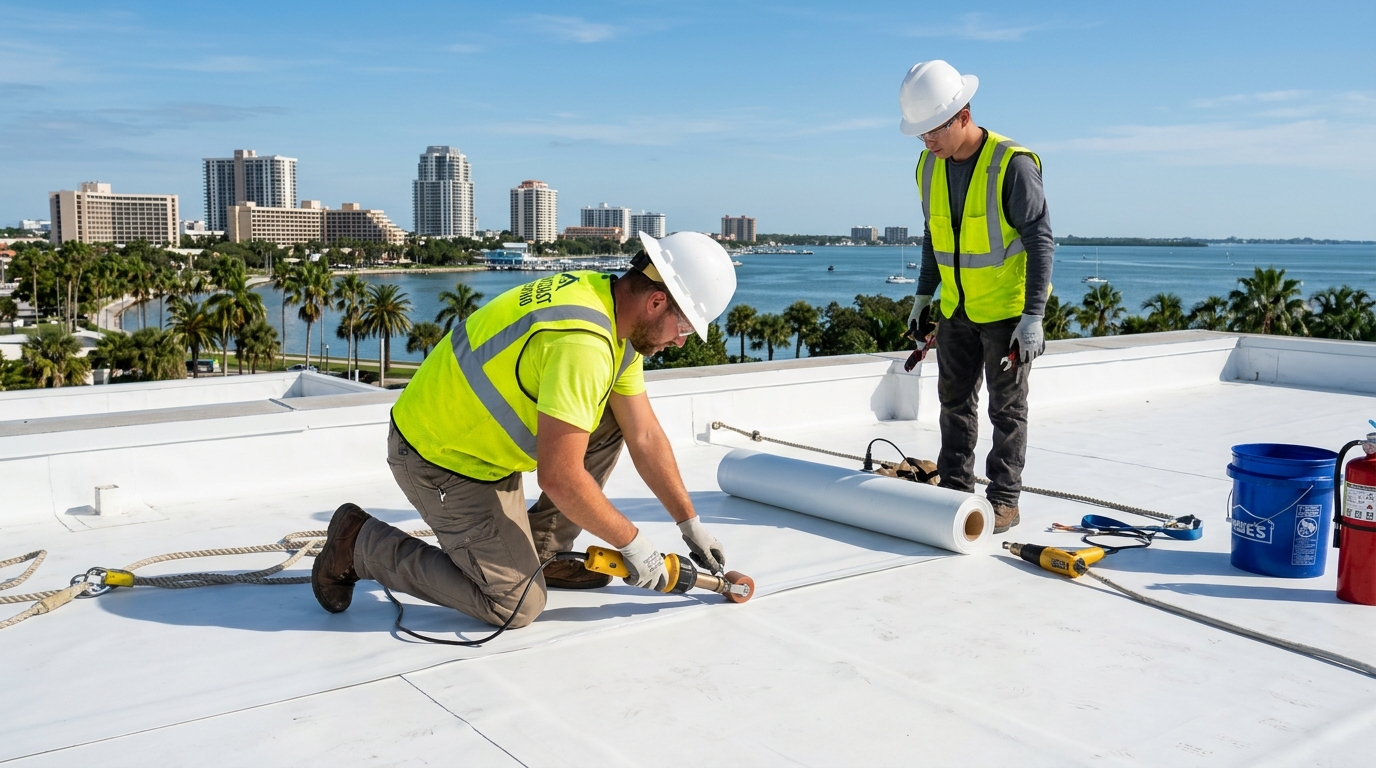
Substrate restoration focuses on structural renewal. Dispatched crews remove storm-damaged shingles and saturated underlayment down to bare decking. Waterlogged, delaminated OSB or rotted plywood is cut out to the center of adjacent rafters, and new APA-rated exterior grade CDX plywood is mechanically fastened with ring-shank nails to restore structural diaphragm strength. Technicians then install self-adhering SBS rubberized waterproofing membranes along eaves, valleys, and penetrations before installing replacement architectural shingles with high-wind six-nail patterns. Fastener depths are calibrated to avoid penetrating electrical conduits, and all metal valley transitions receive 26-gauge galvanized liners.
4. Arkansas Building Code Compliance & Contractor Licensing
All repair procedures adhere to the Arkansas Fire Prevention Code (incorporating the IRC and IBC) and Saline County municipal building standards. Dispatched independent contractors hold active licenses with the Arkansas Contractors Licensing Board under commercial or residential roofing classifications. Technicians strictly adhere to OSHA safety regulations (29 CFR 1926.501) with certified ladder stabilizers and fall arrest harnesses during all roofing operations, ensuring rigorous safety compliance during all residential structural repairs.
5. Preventative Property Maintenance & Severe Storm Preparedness
Homeowners in Bryant and Benton should conduct seasonal ground-level roof inspections every spring and autumn. Looking for lifted shingle tabs, granule accumulations in gutter downspouts, and weathered pipe boot collars allows owners to address minor deterioration before severe storms strike. Promptly repairing minor penetration leaks protects attic insulation, preserves energy efficiency, and prevents costly structural wood rot. Regular gutter clearing also prevents water from backing up beneath eave drip edges during torrential cloudbursts, keeping foundation walls and roof rafters safe from moisture damage.
Frequently Asked Questions
Why does roof decking rot so quickly after a storm leak in Bryant?
High humidity and trapped attic heat accelerate wood rot. Water penetrating past torn shingles saturates OSB decking, causing it to delaminate and lose nail-holding strength within days.
How quickly can emergency roofing contractors arrive in Bryant and Benton?
With on-call independent crews stationed along the I-30 corridor, technicians typically reach Bryant and Benton properties within 60 to 90 minutes of dispatch contact.
Can damaged roof decking be replaced during emergency leak repair?
Yes. Dispatched contractors carry replacement CDX plywood sheathing to cut out waterlogged wood and restore structural integrity during emergency triage.
Speak Directly with a Central Arkansas Dispatch Specialist
Zero web forms, zero digital delay. Direct telephone connection to on-call independent Arkansas contractors.
DISPATCH HOTLINE: (888) 208-4155